Black Estate Treble Waipara Rosé 2023
- Dry style
- Strawberry
- Jasmine
- Unfiltered
Pale pink hue with slight haze as unfiltered. Vibrant and bright aroma of strawberry, jasmine, cardamom and petrichor. The pallet is uplifting, saline and long with flavours of wild raspberry, watermelon, and pomegranate. This is an unfiltered wine with small amounts of sediment. Please allow the bottle to stand and settle before pouring. Drink now to 2026.
The 2023 Black Estate Treble Rose was sourced from all three of our certified organic hillside vineyards in the Omihi sub-district of North Canterbury. Pinot Noir, Chenin Blanc, Cabernet Franc, and Chardonnay were sourced from the Home vineyard ‘Top Block’ which grows on sedimentary clay soils. This vineyard was planted above the original vines in 2011 at a vine density of 6172 vines per hectare. Riesling was sourced from the Damsteep Vineyard which at the foot of the hill has rich Waipara clay soils planted in 2000 at a vine density of 5000 vines per hectare. A small proportion of Pinot Noir was sourced f rom the Netherwood vineyards sandstone soils, planted in 1986 at a vine density of 4500 vines per hectare.
Winter and early spring rainfalls meant vines started the growing season in spring with adequate soil moisture. While spring had numerous cool nights we were able mitigate frost in most blocks and saw even shoot growth. Weather at flowering was settled but cool with intermittent rain resulting in an acceptable fruit set. Post flowering for the second year running we experienced higher humidity levels than normal which veraged 80% through the normally dry December, January, and February months. Thorough leaf removal around the fruit zone was undertaken through the vineyards and spray intervals were tightened up to manage the potentially high disease pressure from powdery mildew. Harvest began in mid March. High quality hand harvested fruit with good ripeness and bright acidity was gratefully obtained.
All grapes were whole bunch pressed and the juice was co-fermented with vineyard yeast in stainless steel tanks. Post fermentation the wine matured on fermentation lees for 4 months. 50ppm Sulphites added. Bottled without fining or filtration. The resulting wine was Pinot Noir (87%), Riesling (7%), Cabernet Franc (4%), Chenin Blanc (1%), Chardonnay (1%).
Product Information
Product Information
Shipping & Returns
Shipping & Returns
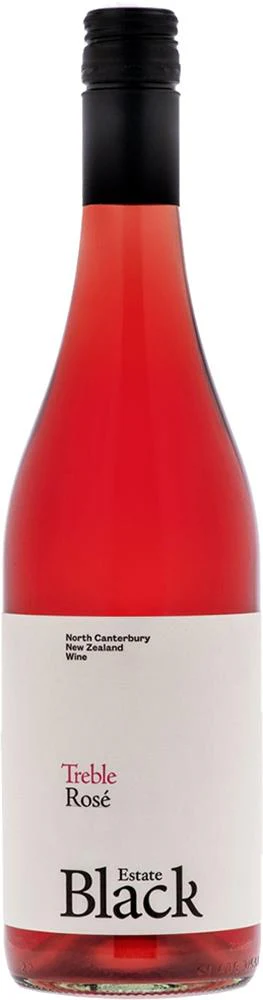

Black Estate Treble Waipara Rosé 2023
Black Estate Treble Waipara Rosé 2023
- Dry style
- Strawberry
- Jasmine
- Unfiltered
Pale pink hue with slight haze as unfiltered. Vibrant and bright aroma of strawberry, jasmine, cardamom and petrichor. The pallet is uplifting, saline and long with flavours of wild raspberry, watermelon, and pomegranate. This is an unfiltered wine with small amounts of sediment. Please allow the bottle to stand and settle before pouring. Drink now to 2026.
The 2023 Black Estate Treble Rose was sourced from all three of our certified organic hillside vineyards in the Omihi sub-district of North Canterbury. Pinot Noir, Chenin Blanc, Cabernet Franc, and Chardonnay were sourced from the Home vineyard ‘Top Block’ which grows on sedimentary clay soils. This vineyard was planted above the original vines in 2011 at a vine density of 6172 vines per hectare. Riesling was sourced from the Damsteep Vineyard which at the foot of the hill has rich Waipara clay soils planted in 2000 at a vine density of 5000 vines per hectare. A small proportion of Pinot Noir was sourced f rom the Netherwood vineyards sandstone soils, planted in 1986 at a vine density of 4500 vines per hectare.
Winter and early spring rainfalls meant vines started the growing season in spring with adequate soil moisture. While spring had numerous cool nights we were able mitigate frost in most blocks and saw even shoot growth. Weather at flowering was settled but cool with intermittent rain resulting in an acceptable fruit set. Post flowering for the second year running we experienced higher humidity levels than normal which veraged 80% through the normally dry December, January, and February months. Thorough leaf removal around the fruit zone was undertaken through the vineyards and spray intervals were tightened up to manage the potentially high disease pressure from powdery mildew. Harvest began in mid March. High quality hand harvested fruit with good ripeness and bright acidity was gratefully obtained.
All grapes were whole bunch pressed and the juice was co-fermented with vineyard yeast in stainless steel tanks. Post fermentation the wine matured on fermentation lees for 4 months. 50ppm Sulphites added. Bottled without fining or filtration. The resulting wine was Pinot Noir (87%), Riesling (7%), Cabernet Franc (4%), Chenin Blanc (1%), Chardonnay (1%).
Original: $110.63
-65%$110.63
$38.72Product Information
Product Information
Shipping & Returns
Shipping & Returns
Description
- Dry style
- Strawberry
- Jasmine
- Unfiltered
Pale pink hue with slight haze as unfiltered. Vibrant and bright aroma of strawberry, jasmine, cardamom and petrichor. The pallet is uplifting, saline and long with flavours of wild raspberry, watermelon, and pomegranate. This is an unfiltered wine with small amounts of sediment. Please allow the bottle to stand and settle before pouring. Drink now to 2026.
The 2023 Black Estate Treble Rose was sourced from all three of our certified organic hillside vineyards in the Omihi sub-district of North Canterbury. Pinot Noir, Chenin Blanc, Cabernet Franc, and Chardonnay were sourced from the Home vineyard ‘Top Block’ which grows on sedimentary clay soils. This vineyard was planted above the original vines in 2011 at a vine density of 6172 vines per hectare. Riesling was sourced from the Damsteep Vineyard which at the foot of the hill has rich Waipara clay soils planted in 2000 at a vine density of 5000 vines per hectare. A small proportion of Pinot Noir was sourced f rom the Netherwood vineyards sandstone soils, planted in 1986 at a vine density of 4500 vines per hectare.
Winter and early spring rainfalls meant vines started the growing season in spring with adequate soil moisture. While spring had numerous cool nights we were able mitigate frost in most blocks and saw even shoot growth. Weather at flowering was settled but cool with intermittent rain resulting in an acceptable fruit set. Post flowering for the second year running we experienced higher humidity levels than normal which veraged 80% through the normally dry December, January, and February months. Thorough leaf removal around the fruit zone was undertaken through the vineyards and spray intervals were tightened up to manage the potentially high disease pressure from powdery mildew. Harvest began in mid March. High quality hand harvested fruit with good ripeness and bright acidity was gratefully obtained.
All grapes were whole bunch pressed and the juice was co-fermented with vineyard yeast in stainless steel tanks. Post fermentation the wine matured on fermentation lees for 4 months. 50ppm Sulphites added. Bottled without fining or filtration. The resulting wine was Pinot Noir (87%), Riesling (7%), Cabernet Franc (4%), Chenin Blanc (1%), Chardonnay (1%).