Thorn-Clarke Sandpiper Merlot 2017 (Australia)
Deep red with purple hues. The nose shows aromas of lifted red plums and five spice with dark cherry notes. The palate is mid weight and juicy with plush, soft tannins. It shows a lively red fruit profile with savoury tones adding restraint and elegance to the finish.
An above average wet spring and cooler than average summer temperatures led to a later start to picking than normal. This combined with a long and mild ripening period meant that our fruit developed to a beautiful level of maturity on the vine. This has led to outstanding flavours and perfumed, expressive wines. The colours are vibrant and tannins are silky with a fine savoury finish.
The grapes are crushed and de-stemmed into fermenters. Yeast is added immediately once in fermenter and the ferments are pumped over twice daily to maximise colour, tannin and flavour extraction. Cooling is used to ensure ferments remain in the 22-25 degrees celcius range which will allow the fruit to display maximum fruit expression. Pressing then occurs approximately seven days after crushing and the wine is then put into a mix of French and American oak to mature (12 months in tight grain French and American oak).
The Barossa vineyard was named by Colonel William Light in 1837, in memory of the British victory over the French in the ‘Battle of Barrosa’ in which he fought in 1811. However, a misspelling on official documents left the region with the name ‘Barossa’. Our Barossa vineyard sites of Kabininge on the Barossa Valley floor, near Tanunda, and in the northern Barossa our St Kitts vineyard adds to the diversity of the Thorn-Clarke estate plantings.
Product Information
Product Information
Shipping & Returns
Shipping & Returns
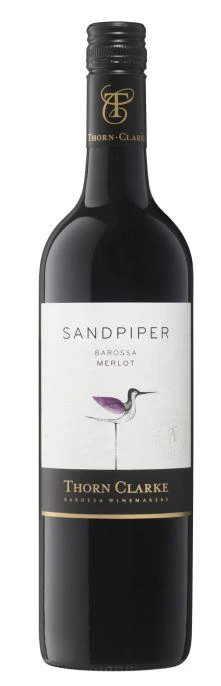

Thorn-Clarke Sandpiper Merlot 2017 (Australia)
Thorn-Clarke Sandpiper Merlot 2017 (Australia)
Deep red with purple hues. The nose shows aromas of lifted red plums and five spice with dark cherry notes. The palate is mid weight and juicy with plush, soft tannins. It shows a lively red fruit profile with savoury tones adding restraint and elegance to the finish.
An above average wet spring and cooler than average summer temperatures led to a later start to picking than normal. This combined with a long and mild ripening period meant that our fruit developed to a beautiful level of maturity on the vine. This has led to outstanding flavours and perfumed, expressive wines. The colours are vibrant and tannins are silky with a fine savoury finish.
The grapes are crushed and de-stemmed into fermenters. Yeast is added immediately once in fermenter and the ferments are pumped over twice daily to maximise colour, tannin and flavour extraction. Cooling is used to ensure ferments remain in the 22-25 degrees celcius range which will allow the fruit to display maximum fruit expression. Pressing then occurs approximately seven days after crushing and the wine is then put into a mix of French and American oak to mature (12 months in tight grain French and American oak).
The Barossa vineyard was named by Colonel William Light in 1837, in memory of the British victory over the French in the ‘Battle of Barrosa’ in which he fought in 1811. However, a misspelling on official documents left the region with the name ‘Barossa’. Our Barossa vineyard sites of Kabininge on the Barossa Valley floor, near Tanunda, and in the northern Barossa our St Kitts vineyard adds to the diversity of the Thorn-Clarke estate plantings.
Original: $55.30
-65%$55.30
$19.35Product Information
Product Information
Shipping & Returns
Shipping & Returns
Description
Deep red with purple hues. The nose shows aromas of lifted red plums and five spice with dark cherry notes. The palate is mid weight and juicy with plush, soft tannins. It shows a lively red fruit profile with savoury tones adding restraint and elegance to the finish.
An above average wet spring and cooler than average summer temperatures led to a later start to picking than normal. This combined with a long and mild ripening period meant that our fruit developed to a beautiful level of maturity on the vine. This has led to outstanding flavours and perfumed, expressive wines. The colours are vibrant and tannins are silky with a fine savoury finish.
The grapes are crushed and de-stemmed into fermenters. Yeast is added immediately once in fermenter and the ferments are pumped over twice daily to maximise colour, tannin and flavour extraction. Cooling is used to ensure ferments remain in the 22-25 degrees celcius range which will allow the fruit to display maximum fruit expression. Pressing then occurs approximately seven days after crushing and the wine is then put into a mix of French and American oak to mature (12 months in tight grain French and American oak).
The Barossa vineyard was named by Colonel William Light in 1837, in memory of the British victory over the French in the ‘Battle of Barrosa’ in which he fought in 1811. However, a misspelling on official documents left the region with the name ‘Barossa’. Our Barossa vineyard sites of Kabininge on the Barossa Valley floor, near Tanunda, and in the northern Barossa our St Kitts vineyard adds to the diversity of the Thorn-Clarke estate plantings.